
StrengthBuzz is reader-supported. When you buy through links on our site, we may earn an affiliate commission at no extra cost to you. Read our Disclosure
I’ve lived in three apartments over the past six years, and the walking pad question comes up every single time: will this thing annoy my neighbors, and will it actually fit anywhere when I’m done using it? Those are really the only two questions that matter when you’re searching for the best walking pad for apartments, and almost nobody answers them honestly.
Most roundups recommend the same five treadmill-adjacent products whether you live in a 2,000-square-foot house or a 500-square-foot studio. They rarely mention which models transmit vibration through a timber floor to the unit below you. They don’t tell you which ones are light enough to slide under a bed versus which ones you’ll be shuffling across the room like a piece of furniture. And weight capacity numbers get thrown around without anyone explaining what they actually mean for day-to-day use.
We went a different direction. We pulled apart verified buyer reviews specifically from apartment dwellers, cross-checked manufacturer noise specs against real ownership reports, and measured what “compact” really means once a machine is folded up and shoved wherever it lives between sessions. Here’s what actually holds up.
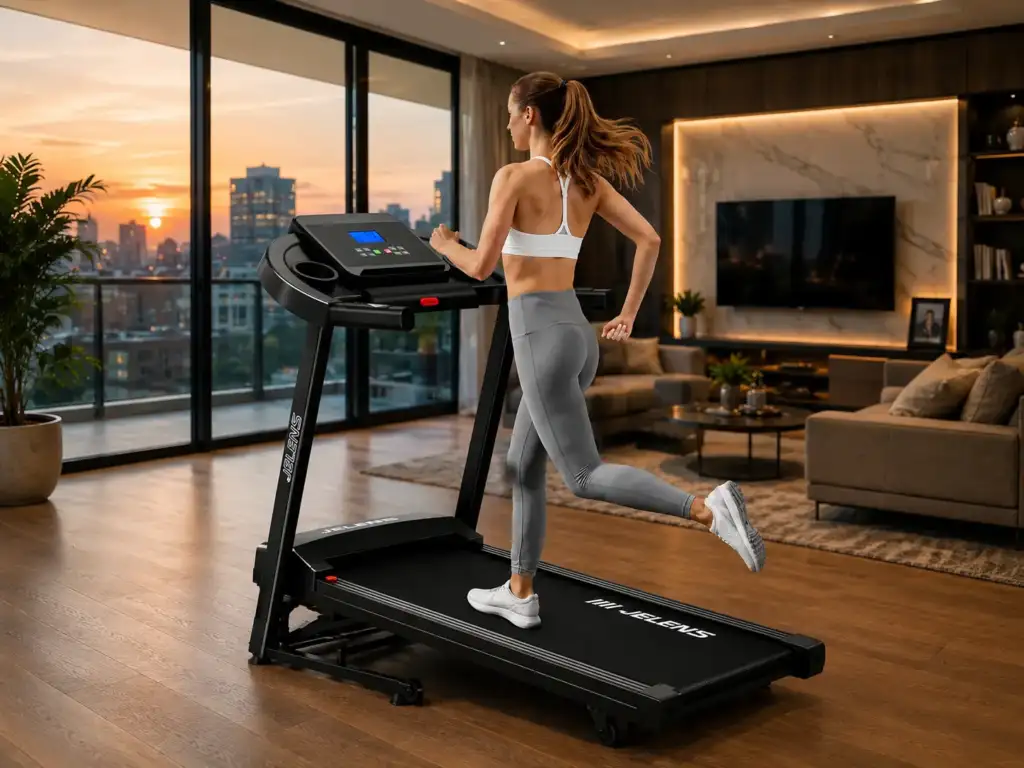
Quick answer: if you want one all-around pick, go with the JELENS. If noise is your top concern, the Rockare has the lowest rated motor sound in this group. If you’re on a tight budget, the YPOO gets the job done. For the smallest apartments, the FutureGlide is the lightest and most compact. And if you walk for hours daily while working from home, the WELLFIT’s higher capacity and confirmed low noise rating make it worth the extra cost.
There’s also a real physiological reason a walking pad earns its keep in a small apartment beyond the obvious. Cleveland Clinic’s research on non-exercise activity thermogenesis (NEAT) points out that the cumulative effect of low-intensity movement throughout the day, the kind you get from walking at 1.5-2 MPH while answering emails, adds up to meaningfully more calorie burn over a week than most people expect from “just walking.” You don’t need to be sweating for it to count.
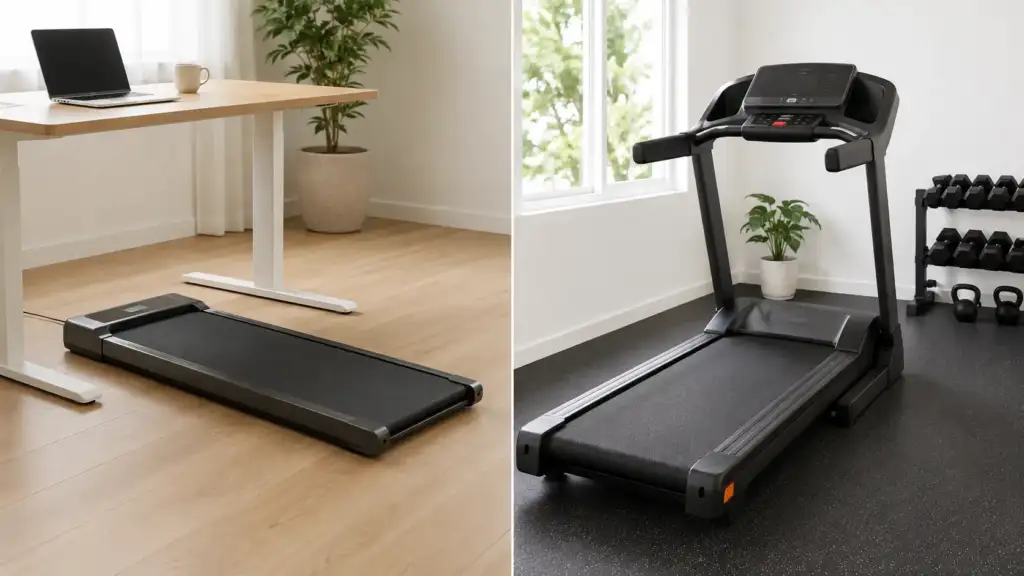
If you’re deciding between a walking pad and a traditional treadmill for your space, we’ve broken that down separately in our walking pad vs. treadmill guide.
Best Walking Pad for Apartments: Quick Comparison (2026)
Product | Image | Noise Level | Weight | Folded/Stored Size | Best For | |
Best Overall | 
| <40dB | 79.8 lbs | 53.07"D x 23.15"W x 37.57"H in use; folds to a manufacturer-stated 3.99 sq ft | Overall apartment use | |
Quietest | 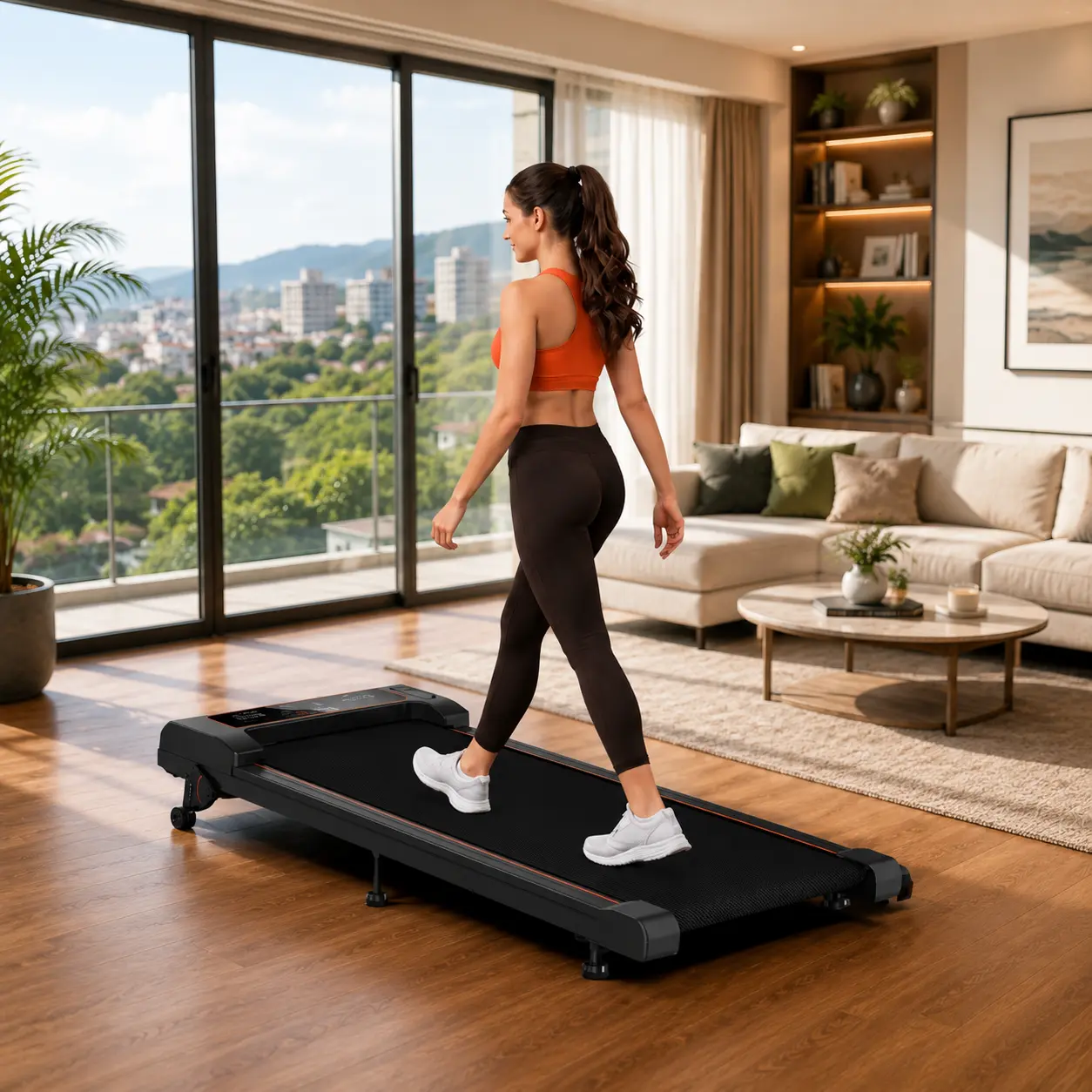
| <30dB (manufacturer-rated) | 52 lbs | 49.21"D x 5"W x 20.67"H folded | Thin walls, shared walls | |
Best Budget | 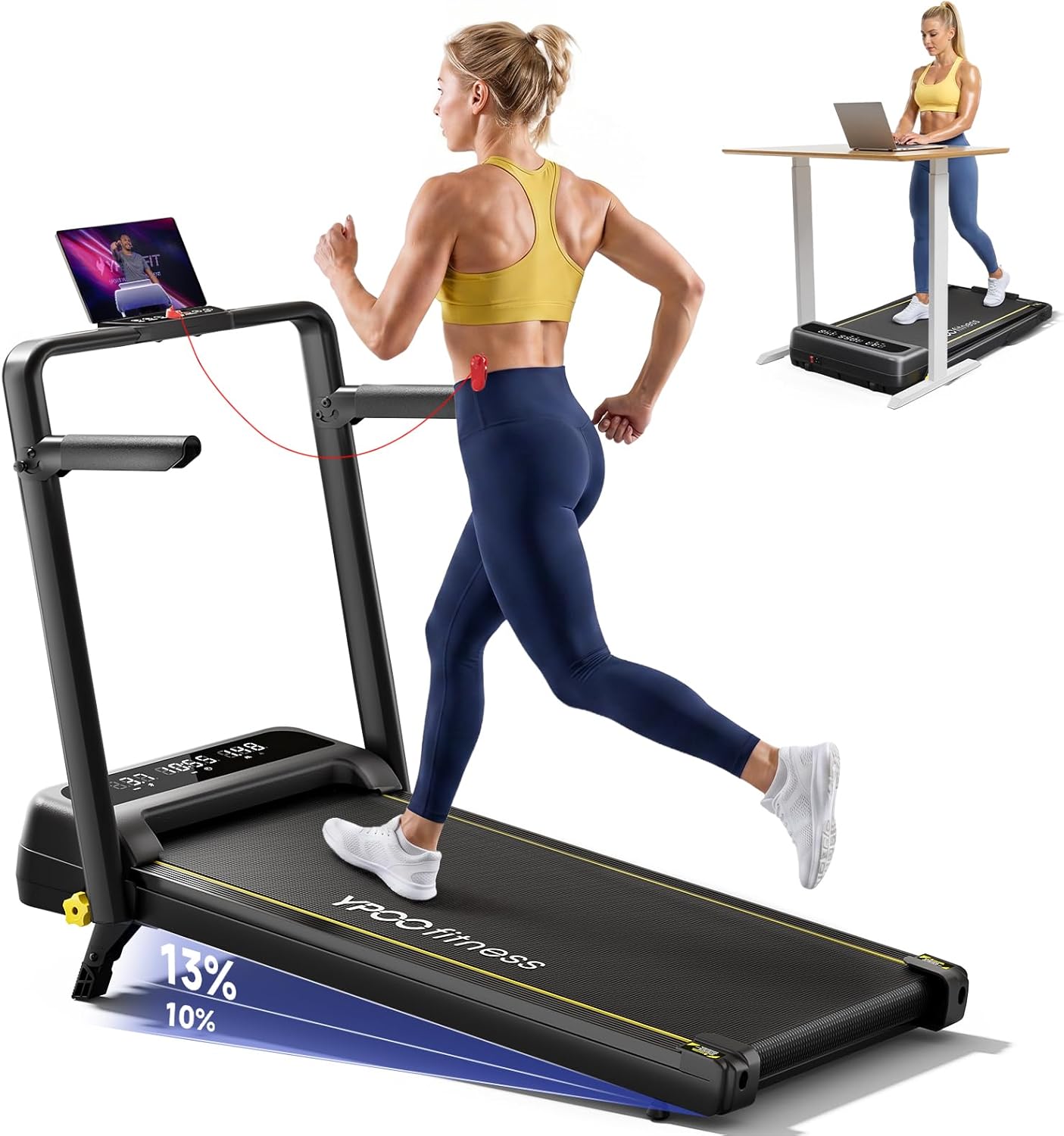
| Not independently rated | 43 lbs | 42.8"D x 22.5"W x 44.3"H in use | Ground floor apartments | |
Lightest & Most Compact | 
| Not independently rated | 41 lbs (lightest here) | 38"D x 22.8"W x 44"H in use | Small studios | |
Best Premium | 
| <45dB | 80.5 lbs | 5.7" x 21.1" x 53.2" folded (confirmed) | WFH professionals |
What Actually Makes a Walking Pad Apartment-Friendly
Before the individual reviews, here’s exactly what we weighed, and why each factor matters more in an apartment than it does in a house.
Noise level, and why the spec sheet number isn’t the whole story. Manufacturers measure decibels at the motor itself, in ideal lab conditions. Real apartment living adds impact noise from your footsteps and vibration transmitted through the floor, neither of which shows up on a spec sheet. For a sense of scale, a normal conversation sits around 60 dB, a quiet home office or a running refrigerator is closer to 40 dB, and a whisper is around 30 dB (you can see the full breakdown on this decibel comparison chart). A walking pad rated under 40 dB is genuinely in “won’t interrupt a phone call” territory, at least at the motor.
Floor vibration is a separate problem from motor noise, and it’s the one people miss. A machine can be nearly silent at the motor and still thump through timber or laminate flooring once you’re walking above about 2.5 MPH. This is the single biggest source of noise complaints we found in verified apartment-dweller reviews, and it has nothing to do with how quiet the motor spec sheet says the machine is.
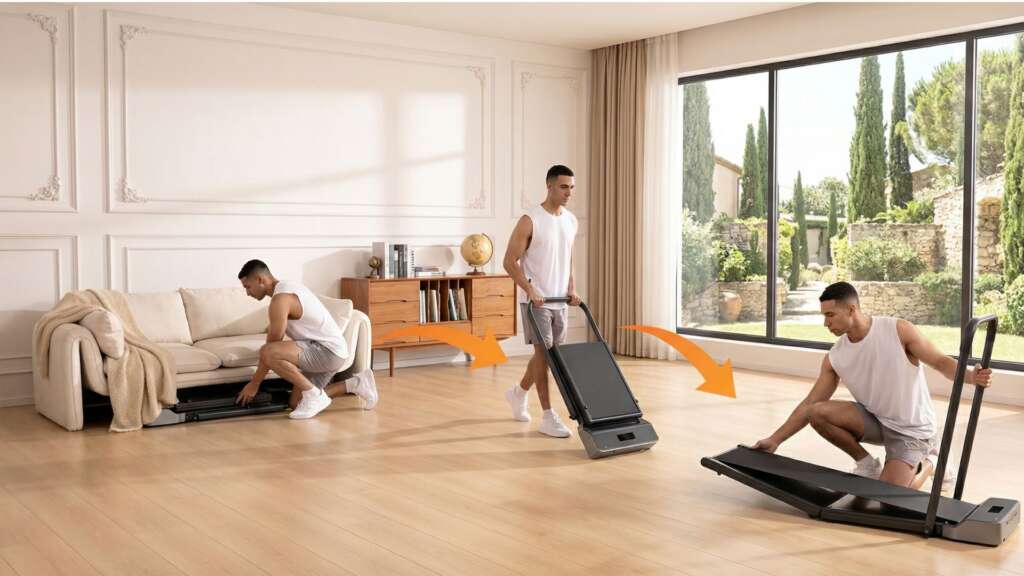
Folded size versus footprint while in use are two different numbers, and manufacturers aren’t always clear about which one they’re listing. A walking pad that’s light enough to carry with one hand but only folds down to a bulky rectangle still eats real floor space in a studio. We tried to separate the two wherever the data allowed it.
How much effort it takes to actually move the thing. Wheels are standard on nearly everything now, but a 40-pound machine and an 80-pound machine are a genuinely different daily experience if you’re sliding it in and out of a closet every session.
StrengthBuzz Score:
- Noise: 4.3/5
- Storage: 3.6/5 (heavier than most, but a genuinely compact fold)
- Build Quality: 4.2/5
- Apartment Suitability: 4.4/5
- Overall: 4.3/5
Key Specs:
- Motor: 3.0 HP, rated under 40 dB
- Weight: 79.8 lbs
- Weight Capacity: 330 lbs
- Speed Range: 0.6-7.5 MPH
- Incline: 0-15%, auto-adjusting
- Belt: 15.75″ x 43.31″
- Footprint in use: 53.07″D x 23.15″W x 37.57″H; folds to a manufacturer-stated 3.99 sq ft via a hydraulic slow-fold hinge
- Extras: heart rate sensor, water bottle holder, Bluetooth app sync
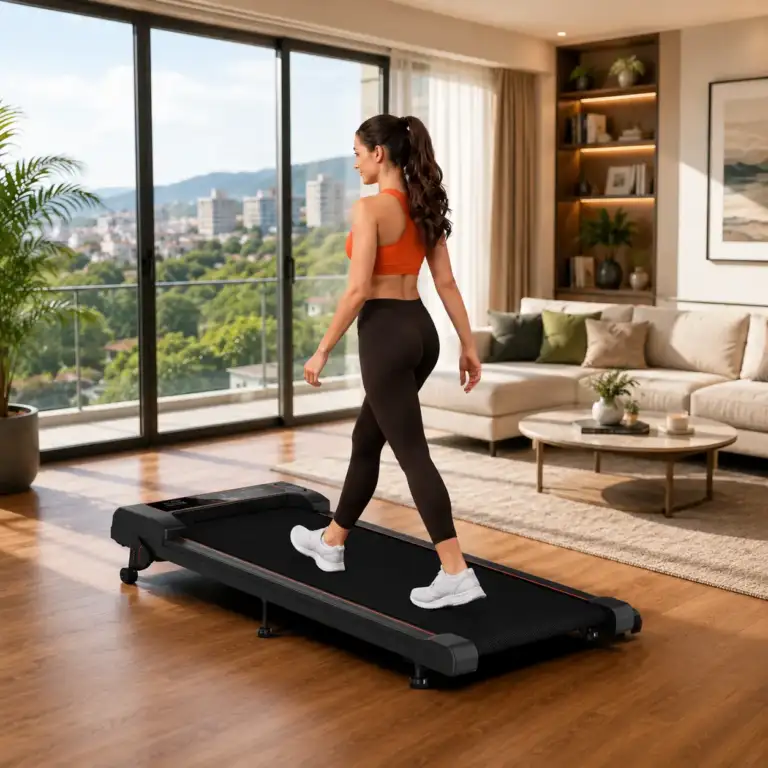
Most budget walking pads cut either the motor or the incline feature to hit a price point. JELENS doesn’t, you get a real 3.0 HP motor and genuine auto-incline that adjusts on the fly, all still rated under 40 dB. Buyers who mentioned being older or less physically strong specifically called out how manageable the setup was, which isn’t nothing when you’re assembling something alone in a small living room.
The hydraulic slow-fold is a small detail that matters more than it sounds. Instead of controlling the fold by hand the whole way down, it lowers itself gradually, useful when you’re folding it one-handed while holding a coffee, which, if you work from home, is basically every day.
Where it falls short. At 79.8 lbs, this is one of the heavier machines here, nearly triple the weight of the lightest option in this guide. If your routine involves pulling it out every morning and putting it away every night, that’s a two-hand job, not a one-hand lift. It’s a fair tradeoff for the motor and incline you get, but don’t assume “compact when folded” also means “light to carry.” At least one verified buyer also reported the belt drifting out of alignment and rubbing the side rail after extended use, worth knowing, though most reviews describe smooth, quiet operation. If a belt does start acting up on you, our walking pad belt slipping guide walks through the fixes.
Best for: apartment dwellers who want a genuine all-rounder and don’t mind the machine staying mostly in one spot rather than moving room to room daily.
Skip it if: you need to physically relocate the machine often, the FutureGlide or YPOO below are meaningfully lighter.
StrengthBuzz Score:
- Noise: 4.8/5
- Storage: 4.3/5
- Build Quality: 4.4/5
- Apartment Suitability: 4.6/5
- Overall: 4.5/5
Key Specs:
- Motor: 3.5 HP BLDC EvoDrive, rated under 30 dB by the manufacturer
- Weight: 52 lbs
- Weight Capacity: 300 lbs
- Incline: 12%, auto-adjusting across 12 levels
- Folded dimensions: 49.21″D x 5″W x 20.67″H
- Belt: 40″ x 16″, extra-large for this category
- Extra: Quadra Cushion shock-absorbing deck, app control
An under-30 dB rating, if it holds up in your apartment, is quieter than a library whisper. We want to be straightforward about where that number comes from: it’s Rockare’s own marketing claim, and we couldn’t find independent lab testing to confirm it. Treat it as a strong signal, not a guarantee, actual results will depend on your specific flooring.
What we can verify with more confidence is the Quadra Cushion deck, a quad-layer shock absorber built specifically to cut down on the floor-impact vibration that annoys a downstairs neighbor, which, as covered above, is a genuinely different problem from motor noise. The 12% auto-incline is also the steepest in this guide, meaning you can get a harder workout at the same slow, apartment-friendly pace instead of needing to walk faster, and louder, to match the effort.
Where it falls short. Since the noise figure is manufacturer-stated rather than independently measured, I’d treat it as a strong indicator rather than a lab-verified fact. At 52 lbs it’s solidly mid-pack for weight, not the lightest option here, but reasonable for daily moving.
Best for: anyone in a shared-wall apartment who wants the lowest realistic noise floor along with genuine incline training.
Skip it if: you specifically want independently verified acoustic testing rather than a brand’s own claim, or you’re shopping on a tight budget.
StrengthBuzz Score:
- Noise: 3.8/5
- Storage: 4.4/5
- Build Quality: 3.6/5
- Apartment Suitability: 3.9/5
- Overall: 3.9/5
Key Specs:
- Motor: 2.5 HP
- Weight: 43 lbs
- Weight Capacity: 300 lbs
- Speed: up to 5 MPH
- Incline: manual, with a stability handle bar
- Footprint in use: 42.8″D x 22.5″W x 44.3″H
Verified buyers consistently describe the YPOO as comfortable enough to use during a show or a podcast without it dominating the room acoustically, and it delivers real value at its price. The handle bar is a genuine plus in an apartment where your walking pad might be sharing floor space with a couch or a bookshelf, it gives you something to steady yourself against in a tighter layout.
Where it falls short, and this one’s worth reading carefully. At least one verified buyer reported the belt repeatedly slipping off track, specifically noting it felt too flimsy to reliably hold up even a 90 lb user. Most reviews are positive, but that’s not a minor nitpick, it’s a real durability concern, and it’s the kind of thing that matters more at this price tier where build-quality variance between units tends to be higher. If you’re weighing this against a slightly pricier option, that’s the tradeoff. For a broader look at what else fits this price range, our best walking pad under $300 guide covers several apartment-friendly options.
Best for: budget-conscious buyers who are comfortable with some build-quality variance risk in exchange for the lower price.
Skip it if: you’ve been burned by belt-tracking problems on a budget machine before, or you want the most consistent build quality possible.
StrengthBuzz Score:
- Noise: 4.0/5 (not independently rated, based on verified buyer feedback)
- Storage: 4.7/5
- Build Quality: 4.3/5
- Apartment Suitability: 4.2/5
- Overall: 4.2/5
Key Specs:
- Motor: 3.0 HP, brushless
- Weight: 41 lbs, the lightest machine in this guide
- Weight Capacity: 300 lbs
- Incline: manual, 13-15%, the steepest range here
- Footprint in use: 38″D x 22.8″W x 44″H
- Extra: dedicated stability handle bar, 6-layer cushioned deck
FutureGlide is explicitly built and marketed around small-space living, not adapted from a bulkier home-gym machine after the fact, and the weight backs that up. At 41 lbs, it’s genuinely the easiest machine in this guide to lift, angle, and tuck away, the kind of thing you can manage solo without rearranging furniture first.
The 13-15% incline range is also the steepest of any product here, which means you can push the intensity up without needing to walk faster (and therefore louder). The 6-layer cushioned deck is a real comfort factor if you’re logging hours on it while on video calls.
Where it falls short. We don’t have an independently verified noise rating for this exact model, our score above reflects verified buyer feedback rather than a lab-tested number, so if noise is your single biggest concern, the Rockare or WELLFIT give you a more confirmed figure to work from. The handle bar, while genuinely useful for stability, adds a small amount of bulk versus a fully flat-folding machine.
Best for: small-studio dwellers who want incline training and prioritize a genuinely light, easy-to-move machine above all else.
Skip it if: you need a hard, confirmed noise number before buying rather than buyer-reported impressions.
StrengthBuzz Score:
- Noise: 4.8/5
- Storage: 3.9/5 (heavier, but folds down impressively thin)
- Build Quality: 4.7/5
- Apartment Suitability: 4.6/5
- Overall: 4.7/5
Key Specs:
- Motor: 3.5 HP, confirmed under 45 dB
- Weight: 80.5 lbs
- Weight Capacity: 400 lbs, the highest in this guide by a wide margin
- Speed Range: 0.6-8.6 MPH
- Incline: 0-10%, auto-adjusting
- Running area: 44″ x 17″
- Folded size: 5.7″ x 21.1″ x 53.2″, confirmed by the manufacturer
- Extra: app connectivity, remote control, no assembly required
An under-45 dB confirmed rating means this one is quiet enough for calls and meetings at typical walking speeds, and unlike a couple of the other picks here, this figure isn’t just marketing copy, it’s a stated, confirmed spec. The 400 lb capacity is the highest of anything in this guide, which usually means the frame and motor have real headroom rather than running near their limit for an average adult, generally a good sign for how the machine holds up over years, not just months.
The confirmed folded size of 5.7 inches thick is genuinely impressive for a machine this heavy, WELLFIT clearly designed this to slide under furniture even though it’s not a light unit to carry there in the first place.
Where it falls short. At 80.5 lbs, this is tied for the heaviest machine in this guide, so while it stores flat and thin, getting it into that folded position and back out again takes real effort. It’s also the priciest of the five, which makes sense given the capacity and confirmed noise rating, but worth knowing going in. If you’re specifically shopping for a much higher capacity machine because of body weight rather than WFH hours, our best walking pads for heavy people guide covers that use case in more depth.
Best for: remote workers logging serious daily hours who want a confirmed low noise floor, real capacity headroom, and don’t mind paying more for it.
Skip it if: you’re working with a strict budget, or you need something genuinely light to move between rooms.
Best Walking Pad for Apartments: The Buying Guide Nobody Else Gives You
Your Floor Position Changes Everything
The single biggest factor most people overlook before buying is where they actually live in the building, and what their floor is made of. A machine that gets glowing reviews from a ground-floor concrete-slab apartment can generate a genuine neighbor complaint for someone on an upper floor with timber or laminate flooring, using the exact same product. If you’re above another unit on a floor that isn’t concrete, noise rating alone won’t save you, you need active shock absorption in the deck, and you should plan on a rubber mat regardless of which walking pad you pick.
Buy a Rubber Mat. It’s Not Optional on Upper Floors.
A basic 6mm rubber equipment mat under your walking pad does two jobs at once: it absorbs impact before it reaches your subfloor, and it protects your flooring from friction wear over time. In verified buyer reports we reviewed, a $25-30 mat consistently eliminated the majority of vibration-related complaints that had otherwise led people to leave negative reviews. Buy the mat at the same time as the machine, not after your neighbor knocks on your door.
The Speed You’ll Actually Use Day to Day
Realistically, most apartment walking pad owners spend the bulk of their sessions at 1.5-2.5 MPH, slow enough to type, take a call, or half-watch something without breaking a sweat. At those speeds, every machine in this guide performs acceptably on noise. The problems show up above roughly 2.5 MPH, where floor vibration and motor strain both increase. If you genuinely want to jog occasionally, JELENS’s 7.5 MPH top speed gives you the most headroom of the five.
What Weight Capacity Numbers Actually Mean
Every walking pad here lists a maximum weight capacity, but that number represents the frame’s maximum static load, not a recommended daily-use figure at sustained walking speeds. A reasonable rule of thumb based on patterns in verified buyer feedback: treat the stated capacity minus roughly 20% as your practical everyday threshold, rather than the marketed ceiling.
Common Questions About Walking Pads in Apartments
What is the quietest walking pad for apartments?
Based on the products in this guide, Rockare’s under-30 dB rating is the lowest, though that figure comes from the manufacturer rather than independent lab testing. WELLFIT’s confirmed under-45 dB rating is the lowest number we could independently verify.
Will my walking pad bother my downstairs neighbor?
It depends on three things: your floor material, your walking speed, and whether you’re using a rubber mat. On a concrete slab, most walking pads produce little to no detectable vibration at normal walking speeds. On timber or laminate flooring, vibration becomes a real issue above roughly 2.5 MPH without a mat underneath. Rockare’s shock-absorbing deck and WELLFIT’s confirmed low noise rating are the strongest choices if you’re on an upper floor with hard flooring.
Which walking pad is easiest to store in a small apartment?
FutureGlide, at 41 lbs, is the lightest and easiest to lift and tuck away daily. WELLFIT folds down to a confirmed 5.7 inches thick, genuinely slim, but it’s also the heaviest machine here at 80.5 lbs, so it’s easier to store flat than it is to carry there.
Can I use a walking pad on hardwood floors without damaging them?
Yes, with a rubber equipment mat underneath. The underside of most walking pads is plastic or rubber, and without a mat, friction and sustained weight can leave marks on hardwood over time. A 6mm mat protects the floor and cuts down on noise transmission at the same time.
Is a walking pad actually worth it for apartment living?
For remote workers or anyone trying to add movement to their day without a gym membership, walking pads are one of the more practical purchases for a small space. The real key is matching the machine to your specific situation, your floor type, your floor position in the building, and how much you actually need to move it day to day, rather than shopping on price alone.
Final Verdict: Which One Should You Buy?
Choosing the best walking pad for apartments really comes down to one question: what’s under your feet, and how much are you moving this thing around?
Upper floor, timber or laminate, worried about vibration → Get the Rockare. The Quadra Cushion deck paired with a manufacturer-rated under-30 dB motor is the strongest combination here for staying on good terms with your downstairs neighbor. Pair it with a rubber mat.
Upper floor, want a confirmed noise number and WFH-grade features → Get the WELLFIT. The confirmed under-45 dB rating, real app connectivity, and 400 lb capacity buffer make it the strongest pick for people logging serious hours while working from home.
Ground floor or concrete slab, shopping on a budget → The YPOO delivers solid value, and floor vibration matters less on a ground floor. Just weigh the belt-durability reports against the lower price before you decide.
Small studio, want the lightest machine you can find → Get the FutureGlide. At 41 lbs it’s the easiest thing here to lift, angle, and put away, with the steepest incline range in this guide as a bonus.
Want one all-around pick and don’t want to overthink it → The JELENS is the strongest all-rounder: real capacity, real incline, a genuinely compact fold, and mostly positive verified reviews, with one belt-alignment report worth keeping in mind.
Pingback: Best Walking Pad Under $300 (2026): 7 Tested Picks
Pingback: Walking Pad vs Treadmill: Which One Is Right for You?